
Overview
- The Canadian Securities Administrators (CSA) are releasing summary results for the Systemic Risk Committee’s annual Systemic Risk Survey. The survey gathers insights from market participants on financial and economic risks.
- Survey responses provide the CSA with critical information on market participants’ concerns about the stability of the Canadian financial system. These results are a key input into the CSA’s ongoing efforts to monitor financial vulnerabilities and promote financial stability.
- The survey was completed by 505 investment dealers and portfolio managers domiciled in Canada between October 16 and November 6, 2025.
- The survey’s response rate was 53%. Aggregated results are reported below on an as-is basis.
Results
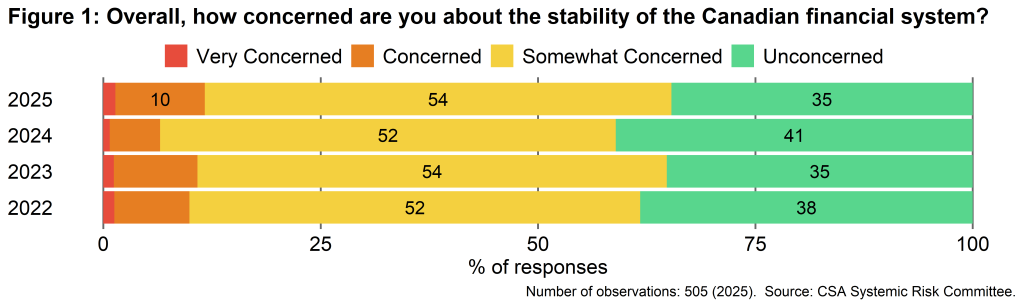
- Concern about financial stability risks has increased since last year. Some 65% of respondents indicated that they were Somewhat to Very Concerned about the stability of the Canadian financial system. That compares to 59% in last year’s survey, which was conducted just before the U.S. election. While concern levels this year are higher than in 2024, they are broadly in line with 2023 levels (Figure 1).
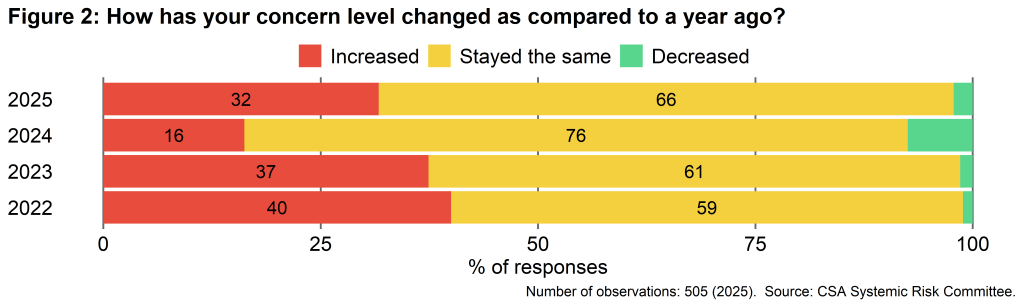
- Some 32% of respondents indicated their level of concern had increased compared to a year ago (Figure 2).
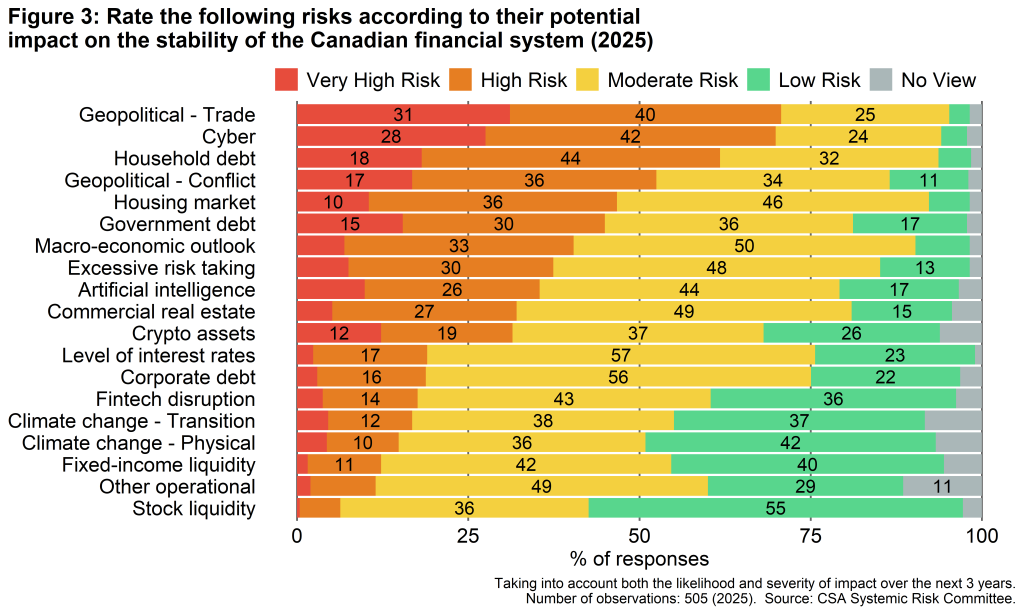
- Respondents were most concerned about trade (geopolitics), cyber vulnerabilities, and household debt (Figure 3).
- Trade concerns were cited most often in the context of ongoing trade tensions. Conflict was also reported as a major concern in the broader geopolitical environment.
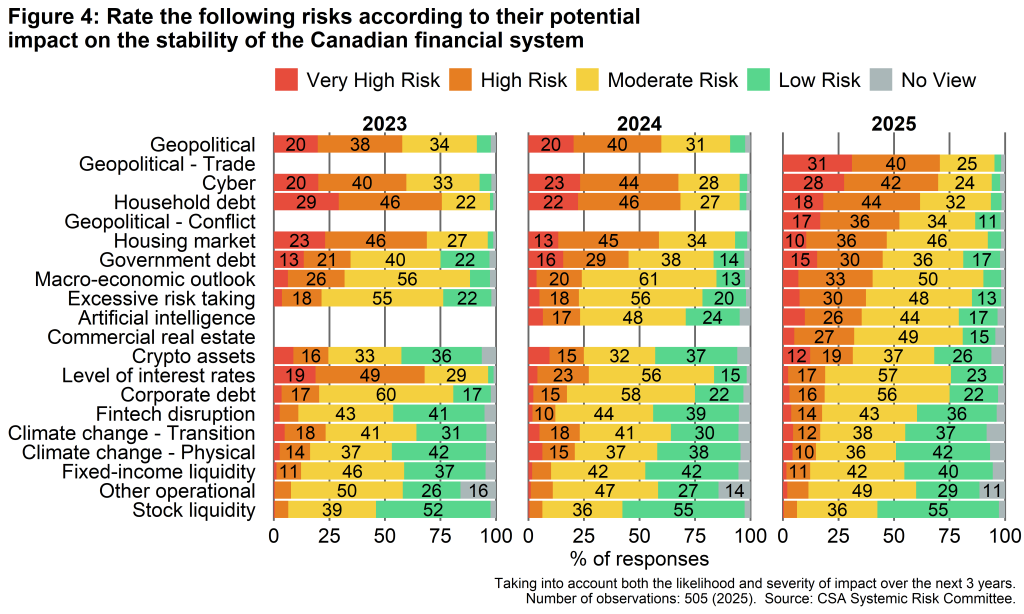
- The share of respondents that viewed cyber security as at least a High Risk increased from 60% in 2023 to 70% this year. While Artificial Intelligence was not cited as a high-level concern, multiple respondents indicated that it contributes to concerns about cyber security, including social engineering and deep fakes.
- Household debt remains a top risk with 62% of respondents indicating that it posed a High Risk or Very High Risk to Canadian financial stability. However, the level of concern has fallen over the past two years, down from 68% last year and 75% in 2023 (Figure 4). Similarly, concerns about the housing market and prevailing interest rates have also edged lower from their peaks in 2023.
If you have any questions, please contact:
John Bulmer
Thought Leadership, Ontario Securities Commission
Email: jbulmer@osc.gov.on.ca
Philippe Bergevin
Economy and Risks, Autorité des marchés financiers
Email: philippe.bergevin@lautorite.qc.ca